Skip to content

{ Monthly Archives } January 2008

Upcoming conferences

I’ll be attending three conferences in the next three weeks (after a hiatus of over two months, it’s going to be strange to get back on a plane), and live-blogging from each conference, wifi permitting.

Next week is the Gartner BPM summit in Las Vegas: one of the key BPM conferences of the year (at least, until Gartner watered it down by running a second one in September last year). The presentations are typically a mix of Gartner analysts discussing BPM, SOA and related subjects, and customers discussing their implementations. The trade show includes every BPM vendor who wants to be taken seriously in this market. Expect to see some of my posts from this week syndicated over on Intelligent Enterprise, plus I’ll be doing a wrap-up article at the end of the week exclusively on their site.

February 13-15 is ARIS ProcessWorld in Orlando, IDS Scheer’s user conference. I attended this last year and enjoyed it; last year was only the second time that I’d been to any sort of process modelling user conference (having attended Proforma’s conference in 2006), and it’s really valuable to see how the front-end modelling tools fit together with the BPMS that automate those processes. IDS Scheer is paying my travel expenses to attend.

February 18-20 I’m back in Orlando for FASTforward, which is sort of a user conference for FAST enterprise search (which is being acquired by Microsoft), but really goes beyond that cover a lot of Enterprise 2.0 territory. Featured speakers include Andrew McAfee, Tom Davenport and Don Tapscott, all of whom I’ve written about in the past couple of week. You can register for FASTforward here, and put my name (Sandy Kemsley) in the reference field so that they know where you came from. FAST is paying my travel expenses to attend. All of my live-blogging posts will be cross-posted to the FASTforward blog, and I’ll do a daily wrap-up post exclusive to their site.

As an aside, I’ve consolidated all posts for all Gartner BPM coverage under one category regardless of year, and all for ProcessWorld under their own category.

If you’re going to be at any of these events, look me up.
BPM, now for dummies

It had to happen: someone is finally grabbing the “BPM for Dummies” (actually, “BPM Basics for Dummies”) title and are running with it.

Software AG is publishing this book very soon (in January, according to their site), and you can register for a free print copy here. According to the description:

Business Process Management (BPM) is useful, powerful and potentially very accessible. But, with so many analysts, consultants, publications and vendors weighing in with their own perspective and opinions, it can be very confusing.

Business Process Management Basics For Dummies will help you understand what BPM is really all about. Whether you are a business manager or an Information Technology practitioner, this book will provide valuable information about what BPM can do for you—and how to apply it.

This book includes:

  • Core concepts and practical ideas.
  • A primer for getting started with BPM.
  • A step-by-step guide for implementing BPM successfully.
  • A compilation of resources that you can go to for additional help or continued education.

I find it a bit ironic that they seem to be dissing the opinions of vendors (”But, with so many analysts, consultants, publications and vendors weighing in with their own perspective and opinions, it can be very confusing), yet this book is written by three Software AG employees.

Mapping BPM Events

Coincidentally on the same day that Todd Biske and I start collaborating on the BPM, SOA and EA calendar that you can find on both our sites, I saw this amazing post (linked from the Google Operating System blog) showing how to map a Google calendar’s events on a Google map, with a bit of help from a simple Yahoo Pipe. The results, showing our events calendar, can be found immediately beneath the calendar.

The theory is that this should refresh from the pipe (and hence the calendar itself) every time that you visit the page — or, if you prefer, a link to a larger version of the map directly in Google Maps — although I haven’t tested that out.

If you’re an author on the BPM Google calendar, be sure to fill out the location field so that your event is displayed on the map.

Definitely the most fun that I had all day.

links for 2008-01-29

Business analyst mindmap

This is my day for having friends post amazing business-related graphics. This one (you’ll need to click through to the full-size version in order to see the detail) is by Bryce Johnson:

Business Analyist, User Experience, Front-End Architecture Practice MindMap

BPM Events calendar gains a new audience

Todd Biske, whose blog I read regularly, announced last week that he was going to publish a Google calendar of BPM, SOA and EA events, I invited him to join the one that I’ve been running for a few months. During the time that I’ve had the calendar active, I’ve added about 10 other authors to the calendar who can add events; these are typically people very active in the industry and have events to contribute. If you want to add an event, you can email to either Todd or me; if you think that you can make an ongoing contribution, then let us know and we’ll add you as an author.

You can view the calendar on my site here, or on Todd’s site here. If you have a blog on a related subject, feel free to embed it on your site as well. Good place to check first if you’re organizing an event and want to make sure that it won’t conflict with competing events.

Process graphics

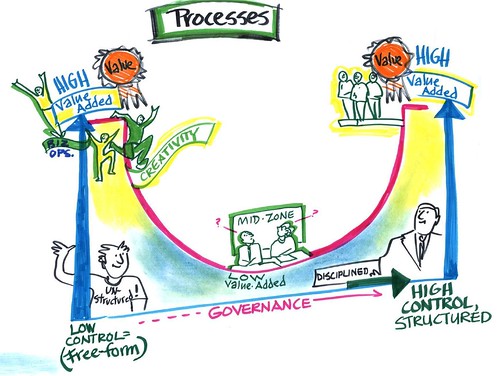
I’m not sure that I understand all of the meaning in this graphic, but I love it! Posted by Marilyn Pratt of SAP’s BPX.

process image

links for 2008-01-28

Metastorm’s New Account On-Boarding process pod for financial services

One of the things that Metastorm has released recently is a series of solution frameworks that they call “Process Pods“, which include prebuilt rules, dashboards, KPIs, and technical integrations in addition to prebuilt process models; however, they’re not truly productized in that they’re supported by the Professional Services group as if they were customized work.

The latest of these process pods is targeted at the financial services market, specifically new account opening: an area that often requires both electronic and paper-based data collection, background checks, new account creation, and updates to existing account and client records (Metastorm press release here). In addition to the process flows and rules of other process pods, this one also uses Metastorm Integration Manager product (which is, I believe, what the CommerceQuest acquisition turned into) to integrate the legacy applications (including CICS) that are typically used for client on-boarding tasks in financial services organizations. Although there will still need to be customization, the idea (as with most BPM frameworks) is that the time to deploy a productive, integrated solution will be greatly reduced.

I checked out their hour-long recorded demo of the New Account On-Boarding process pod (registration required, and didn’t seem to be Firefox-friendly). It’s pretty low-resolution and the audio is a bit sketchy, but you can get an idea of how a process would look as implemented with their NAO process pod, including the following features:

  • CICS integration both for retrieving data and creating the new account on the legacy mainframe system.
  • SharePoint portal integration, plus standard JSR168 portal integration into a Pluto portal; there are a number of portlets that can be embedded, such as a task to-do list, a watch list, a search form, and a form to create a new account (which presumably kicks off a new process instance).
  • Email integration for alerting process participants.
  • Data entry forms including links to data validation for things such as customer/account number, and enforcement of required fields.
  • Checks for conditions such as specific countries of origin and amount of investment to trigger any anti-money laundering or other rules for further investigation.
  • Identify verification to satisfy know-your-customer regulations, including checking against third-party blacklist checking services.
  • Risk assessment checklist.
  • Electronic signature and date-stamp at key points, such as completion of due diligence.
  • Removing tabs from user interface at points in the process to limit access to information by certain user classes.
  • Document attachments.
  • After-the-fact batch reports.
  • Dashboards with KPIs; these appear fairly rudimentary, but are actionable by allowing drill-down to the actual process instances.
  • A third (!) separate business intelligence product that also produces reports and dashboards.
  • Administrative functionality to allow control of many of the process parameters via table values, e.g., adding new questions to the risk questionnaire and indicating how each possible answer contributes to an overall score. There are some aspects of this with which I disagree, such as specifying parallel and serial process paths by creating table entries for each logical node in the process map, and assigning the order: this is the way that we used to do process maps before there were graphical process mapping tools.

One issue that I have with the demo is that it shows a finished product from a user point of view, without much of an indication (besides the administration table values) of how much effort is required to build this solution based on the NAO framework, or what is even customizable in the framework. For example, I suspect that some of the processes, rules and data fields in their standard process pod are US-specific, although they should be customizable with some additional help.

There are some things that they sell as features that look a bit clumsy, such as calling out to MS-Word for spell-checking within a note entered in a web form. Also, early in the demo, she shows the process model in ProVision, but not obvious that this maps directly to the Metastorm execution environment — I’ve seen some comments that indicate that it’s not so easy to pass models back and forth.

The demos a bit long, and an interactive demo is always better, but this does take you on a pretty thorough tour of what can be done with their process pod. And, I managed to get all the way through this blog post without a reference to pod people, invasion of the body snatchers, cocoon or many other great sci-fi usages of the word “pod”.

Linking SOA Governance with BPM

Software AG is holding a webinar tomorrow at 11am Eastern that will talk about how the recent Gartner Magic Quadrants on BPMS and SOA Governance interrelate. I can’t make it, but you can register to attend here; apparently it will be available for replay after the event.

Even public service organizations can ‘camp

Normally I would just provide a link to this in my daily Links post, but this is such a great example of how Open Space technology (e.g., BarCamp, MashupCamp) can be used for more than just holding geeky tech unconferences: last year, three people from the TorCamp community organized TransitCamp to provide a place for the Toronto Transit Commission (North America’s third largest, serving 2.4 million riders each day) and the local community to come together and generate new ideas about how to really make the TTC “the better way”. Today, the story of TransitCamp, “Sick Gloria Transit”, hit the Harvard Business Review as one of their breakthrough ideas for 2008. The article is written by Mark Kuznicki, Jay Goldman and Eli Singer; Mark’s post also contains a number of reference links, including a page of links on the TransitCamp site covering both unconferences and TransitCamp itself.

I’ve attended several unconferences, although I missed TransitCamp last year, and I’ve been promoting the idea of the unconference as a format for business and technology conferences in the BPM space, but it’s a hard sell. One group of conference organizers that I approached with this had many reasons why it wouldn’t work, even though they have never attended an unconference, and most didn’t know what it was before the subject was broached. One response: “hopelessly techie.” I disagree: the unconference format has been used for many non-technical gatherings since Open Space Technology was first defined in 1986; it’s just that the tech community made it popular in the past few years. To quote the Wikipedia article, it “has been used in over 100 countries and in diverse settings, industries, cultures and situations - for program and product design, knowledge exchange, interdisciplinary thinking, conflict resolution and conferences.”

TransitCamp is a great example of how unconferences can be used with a primarily non-technical group of participants to generate ideas for a definitely low-tech endeavour: improving our local transit.

Lombardi analyst call: executive re-org and 2007 results

Lombardi held an analyst conference call last week in advance of today’s press releases — a relatively new format for them — to discuss their executive reorganization against the backdrop of their 2007 results and 2008 strategy. Rod Favaron, CEO (and, until last week, President) and Phil Gilbert, President (formerly CTO) gave us the update. The press releases are here and here.

In 2007, Lombardi had a revenue growth of over 60%, which is actually a drop from their previous growth of over 100%, but still pretty healthy; in 2008 they expect it to stay around 60%. Given the current climate of impending recession in the US, I’d be surprised if they achieve that, but I expect that they’ll still continue show strong growth based on their now-established track record of 7-figure sales. In fact, they think that hard economic times can actually drive sales of BPM.

They’re starting to expand internationally: 35% of their sales were outside North America, mostly Europe, likely helped along by the European office that they’ve expanded to assist their direct sales and resellers in the region. Not having to fly people back and forth from the US all the time would definitely be a big help both in terms of reducing the cost of sale and providing local support, and this marks a significant milestone for any growing US software company that is selling internationally or dealing with multi-national companies. Alan Godfrey, formerly EVP of Marketing, has moved to London to scale up the European operations, and their former European sales head has moved on to build out the Australian and southeast Asian market.

They claim that they started 2007 competing against the pure-plays (e.g., Savvion, Appian), and ended it competing against the stack vendors, with most of their competition now from IBM, Oracle/BEA, TIBCO and Pegasystems.

From a product and services standpoint, they’ve combined platforms (Teamworks and Blueprint), solutions and professional services all under Phil Gilbert as a Global Business Solutions group that builds product and packages combinations of product and services (such as process analysts and mentors) into solutions. Their major upgrade to Teamworks in 2007 included some new SLA and KPI monitoring to allow business people to understand the process in business terms, not technical terms, and the release of Teamworks for SharePoint to allow collaboration in SharePoint within the context of a structured Teamworks process.

They’ve had a good uptake with Blueprint, their SaaS process modeling tool. They expect to end 2008 with the best business-facing process modeler in the industry, by which I think that they mean Blueprint. A major update to Blueprint is due in April, and mid-year they’ll merge the Blueprint and Teamworks repositories, which I think is a significant step forward. A major release to Teamworks is due in the second half of the year; a pre-release version is already available to some customers, which bodes well for them actually making their release dates.

In April, they’ll be offering some joint product/services packaged offerings, including a focus on modeling, optimization and helping customers to establish an internal BPM center of excellence. Productizing a package of services is a logical step for Lombardi, but puts them in direct competition with their partners in regions where they sell through partners. Even if they’re using the partners as subcontractors in these packages, I’ve seen first-hand in the past with other BPM vendors how this can alienate the partner channel, which in turn impacts growth.

What is great to see is that Lombardi is promoting a lot from within: a few people who I know (in addition to Phil) have been moved up in the ranks to take on more responsibility, and all are well deserving. Nothing better for company morale than promoting someone who’s capable and well-liked rather than hiring in a big gun from outside.

I’m guessing that taking over as president is going to give Phil even less time to blog, but maybe that will encourage him to embrace Creative Commons and publish his book on there as a serial.

Fujitsu trying to lose the "best-kept secret in BPM" label

Fujitsu’s been in the BPM market for quite a while, but in the past has focused on OEM relationships with their BPM embedded within another vendor’s product. They’ve made more of a push lately on their North American marketing, and part of that is a series of seminars that they’re conducting in a few cities across Canada: Toronto and Ottawa this week, and some western locations likely to follow. I attended the Toronto seminar this week, which was given by Carl Hillier, a former colleague from my long-past days at FileNet. Carl’s been with Fujitsu for over a year, and is now part of Fujitsu’s push to market their name as a BPM vendor. What I like about attending a presentation with Carl (besides the obvious heckling) is that he always has some good material that I can borrow for my own future presentations. :)

The 2-hour presentation had 3 sections: BPM 101, quantifying BPM ROI, and a quick look at Fujitsu’s Interstage BPM product. The product part at the end was really brief, about 15 minutes, and the rest was pretty generic and could apply to any BPM product. Except for one in-the-weeds section about the specific technology of Interstage, this was appropriate for both business and technology attendees, and the audience was split about 50:50.

He started with some interesting messaging about BPM: BPM is not necessarily visible, it may be customized to look like other applications, or may be implemented “below the waterline” within other environments. Although this has definitely been the case for Fujitsu in the past with their OEM tendencies, I’m not sure that this is true for most other BPM vendors, many of whom prefer to have at least some degree of out-of-the-box implementations where their product is highly visible. That being said, I am starting to see a lot of BPM tucked into portal interfaces, where it is less visible.

He had the usual high-level definition of BPM — automation + integration + optimization — and went on to list drivers for BPM:

  • Dynamic business environment
  • Lack of process visibility
  • Regulatory compliance issues
  • Inter-corporate collaboration
  • Cost reduction
  • Inability to sustain growth
  • Complex process logic (i.e., you can’t freeze a complex process once created, it still needs to remain agile)
  • Re-use best practices in processes

As he points out, the first deployment of a BPM project is just the beginning of the lifecycle: if your process will never change, then you may as well just code it in Java, but we use BPMS exactly because the process will change and we need greater agility. He also recommends (and I concur) against spending too much time analyzing the as-is business processes; remember that if those processes were so good, then you wouldn’t be looking to automate or replace them. The idea of any BPM project is to liberate the process from the application code, separating the process from the services and underlying enterprise applications. It’s not all about automating process steps; automation can be used effectively to reduce process latency and improve route determination between manual steps, as well as automate some steps.

He also discussed business rules, and showed a changeability spectrum with coded applications being the least changeable, processes more changeable, and rules the most agile of all — a view that I’ve been discussing in the crossover between BPM and business rules lately. He added an interesting distinction between auditing and logging when it comes to BPM: process auditing includes the data upon which decisions were made in order to later justify that decision for compliance purposes, whereas logging may just be recording the decision that was made.

He finished the BPM 101 section with a great slide on how to tell when you don’t need BPM: it starts with “your processes are really simple” and “your processes never change” (okay, I’ve heard these reasons before), then goes on to “you don’t care what your customers think” and through a series of other giggle-inducing reasons, ending with “you want a clumsy, complicated architecture”.

Keeping the light tone, Carl opened the section on quantifying BPM ROI by stating that “ROI is king…and not just in French”, a bilingual pun that I’m sure went over better when he presented in Ottawa later in the week. :) He did present an interesting list of the five E’s of BPM ROI (paraphrased here as I was jotting down notes as he spoke):

  • Elevate business logic: reduce change management overhead, and minimize the requirement for users to know everything about a process by having the system enforce the business logic where possible.
  • Eliminate process latency: reduce cycle time, increase productivity, and meet SLA/compliance targets.
  • Enforce process integrity: disallow rule bending, ensure and demonstrate compliance, and allow rapid deployment of changes
  • Enhance process execution: parallel processing, workload balancing, and location independence.
  • Ease task execution: eliminate process errors, and eliminate what can be automated.

This is definitely a good starting list when you’re looking for the ROI in your BPM initiatives. He also explicitly talked about the ROI of integration between BPM and other applications: eliminating redundant data entry and increasing accuracy are the two big ones, but there’s also value in having the staff focus on adding value rather than re-entering data between systems.

He finished the seminar with a brief demo of Interstage: mostly a few screen snapshots and some slides about functionality, then a brief view of the simulation screens. Like several other BPM vendors, Fujitsu has a free download of their BPM Studio modeller (not sure if there are restrictions on the free version) as well as having a Process Designer applet that runs in a browser. Interstage, likely because it’s been used as an OEM product, seems to have a good balance of built-in functionality as well as the ability to easily integrate with third-party products that provide more robust functionality, whether it’s for content management or business rules. I haven’t looked at Interstage for almost a year (which I belatedly reviewed in June), but I’m sure that I’ll have a chance to see them next week in Las Vegas at the Gartner BPM show — an event where what happens in Vegas does not stay in Vegas.

Carl mentioned an Interstage case study at the end, and although it’s great when US companies try to show their support of the Canadian market, an Edmonton power utility company is a long way from the financial district of Toronto, both geographically and culturally. Even Google Maps knows that the shortest distance between the two is through the US.

links for 2008-01-23

links for 2008-01-22

links for 2008-01-18

links for 2008-01-17

links for 2008-01-16

BEA picked up by Oracle

After a lengthy and tempestuous courtship, Oracle is finally acquiring BEA for $8.5B, a healthy increase over the original $6.7B offer last October. It will be interesting to see what emerges on the BPM and SOA product front from the combined organization; some large acquisitions in the past, such as IBM acquiring FileNet, seem to have caused more confusion than clarity in the market.

links for 2008-01-15