Skip to content

{ Category Archives } open source

Jason Laszlo gives Bell Canada a(nother) black eye

All week, the local tech community has been buzzing around the news that Bell Canada is throttling P2P traffic — specifically the widely-used BitTorrent protocol — for not only their direct Sympatico subscribers, but also for anyone who buys their supposedly unlimited DSL from a Sympatico reseller, such as TekSavvy. For those of you new to the traffic shaping/net neutrality wars that have been going on in North America over the past months, here’s why throttling P2P traffic isn’t good news:

  • Bell Canada (and our only other "last mile" carrier, Rogers Cable) are violating their role as a common carrier: they’re supposed to deliver the data, regardless of what it is, subject to our individual bandwidth and download caps. As long as I’m not getting a higher bandwidth than I was promised, and don’t go over my monthly volume cap, I should be able to download whatever I want, whenever I want, because the contract that I signed with Bell implied that would be the case. If they can’t deliver that bandwidth, then they shouldn’t be selling it; furthermore, they should have taken the money made by all these years of overselling the same bandwidth and invested in improving the now-outdated infrastructure so that we wouldn’t have these problems now.
  • The carriers, Bell and Rogers, like to position this as allowing equal access to everyone instead of allowing those evil file-sharing types to hog the bandwidth, but they don’t exactly have altruistic motives: both of them sell services (cable and satellite TV) that compete with downloaded video, and they want you paying $40+ to them each month to watch the TV that they choose rather than be able to select from a wide variety of alternative — and legal — video available on the internet. Furthermore, Rogers wants to use the same bandwidth that you would use for free video downloads to download their pay-per-view movies instead.
  • Bell and Rogers have targeted the BitTorrent protocol for throttling even though it has many legal uses. Last week, CBC made history by offering a TV program available, DRM-free, for download by BitTorrent. This allowed anyone in the world with broadband access to have access to Canadian programming that might not be available on their local TV stations. By throttling BitTorrent, however, Bell and Rogers are effectively blocking access to that Canadian content within Canada, forcing people to watch it on Bell or Rogers’ TV services. Personally, I use BitTorrent not just for that CBC show, but to download new releases of Ubuntu, and other large open source downloads where the source site provides BitTorrent as an option in order to reduce the bandwidth demands on their servers.

What this all comes down to is a violation of net neutrality: Bell and Rogers are deciding which traffic on the network gets higher priority. They’re doing it now because they’ve failed to make the necessary investments in infrastructure over the years that would allow them to actually deliver what they sell, and coincidentally they choose to throttle traffic that competes with their other business areas.

Suffice it to say that Bell Canada didn’t have a good week because of this — it was all over the news, the DSL resellers are talking about suing, and even the unions are in on the action. Enter Jason Laszlo, a spokesperson (apparently associate director of media relations) for Bell Canada, who was quoted extensively on this issue in the press:

  • "Regarding customers like Mount Sinai [a major Toronto hospital that was used as an example of how legal file sharing might be used for CAT scans], Laszlo said it’s their own fault for using a notorious application like file-sharing. ‘We’re blind to the content flowing through our pipes,’ he said. ‘Our goal is to ensure maximum efficiency for everyone.’" — Digital Journal, March 25th. ["Notorious"? Oh, puh-leeze. And if they were blind to the content, then they wouldn't be throttling file sharing.]
  • "P2P programs are only employed by a small percentage of internet users, but they tend to make use of all the available bandwidth, Laszlo said. Reduced P2P use should provide a better balance between P2P and other users at peak times, he said. ‘I feel we’re on the side of good,’ he said." — CBC News, March 25th. [Throttling P2P is a good way to make sure that it is only ever employed by a small percentage of users, which is exactly what Bell wants.]
  • "Bell spokesman Jason Laszlo on Friday reiterated the company’s position —that it was shaping traffic in order to prevent a small portion of bandwidth hogs from slowing speeds down for all customers." — CBC News, March 28th.
  • Jason Laszlo (Bell Canada media relations) on Facebook"Jason is throttle-icious." — Jason Laszlo’s publicly-viewable Facebook profile, status update dated March 28th at 4:34pm.
  • "Jason is realizing how little seperates [sic] most journalists from lemmings." — Jason Laszlo’s publicly-viewable Facebook profile, status update dated evening of March 28th.

Yes, those last two are real; his Facebook profile was posted on a broadband discussion forum yesterday afternoon (you can Digg the story here); he obviously was unaware of the impact of no privacy settings, since I was able to access his profile immediately after that even though we’re not directly connected and have no mutual friends.

My friend Mark Kuznicki channeled his outrage into a great blog post about how this hands the net neutrality advocates a gift, and messaged Laszlo on Facebook to let him know what we all think of his two-faced approach to media relations. Shortly after that, Laszlo’s profile was set to private so that I could no longer view it; this morning, it appears to be completely missing.

So what’s the lesson to be learned from this mess? The public is now aware and mobilized on the impact of traffic shaping on their daily lives, even if they haven’t yet heard the term net neutrality. To paraphrase Peter Finch’s character from Network, we’re mad as hell and we’re not going to take this anymore.

Oh, yeah, lesson #2: don’t entrust media relations for a sensitive subject to an inexperienced junior who doesn’t know well enough not to post inappropriate comments to his publicly-viewable Facebook profile.

Shared Insights PCC: AvenueA|Razorfish intranet wiki

I skipped this morning’s taxonomy/folksonomy smackdown featuring Seth Earley and Zach Wahl — I just wasn’t up for that much testosterone this early in the morning – and went to the best practices track to hear about how AvenueA|Razorfish implemented their internal wiki. I’m speaking next, so if this session isn’t sufficiently riveting, I’ll duck out early to review my notes.

Donna Jensen, their senior technical architect, took us through how they use a wiki as an intranet portal. She spent some amount of time first defining wikis and discussing benefits and challenges, particularly when used inside the firewall. She made a crack about how Ph.D. dissertations will be written on many of these points, which isn’t that far from the truth: things like encouraging active versus passive behaviour. And, although she claims that they’re breaking down behaviours tied to organizational silos, she admitted that no one can comment on the CEO’s blog although all others are open territory. At some point, even the top level executives have to learn that if they’re going to commit to Enterprise 2.0, it has to permeate to all levels of the organization: no one should be exempt.

The platform that they used was MediaWiki (the software used to create Wikipedia) on a standard LAMP stack, giving them a completely open source base. They also use WordPress for internal blogs, maintaining the commitment to open source. Although they did do some customization, particularly in terms of creating templates such as project pages, they took advantage of many freely-available third-party extensions for functionality such as tag clouds, calendaring and skins. They use Active Directory for security, and allow access only internal or VPN access: no external access or applications.

AA|RF put in the wiki with only a technical VP and a part-time intern, pretty much out of the box, and found that it wasn’t adopted. They did another cut with Jensen as technical architect (part-time) and a couple more interns, and arrived at their current state: no project management oversight, no content management system, and no creative designer, with the whole thing implemented in about 2,000 person-hours. As a web technology consulting company (although with little Web 2.0 experience), they can get away with this, but you may not want to try this one at home. They used agile scheduling, and eventually brought in some rigorous QA. Jensen feels that their only real mistake was not bringing in a create designer earlier, since the wiki is apparently pretty technical looking. They haven’t yet put a WYSIWYG editor so everyone still needs to work in WikiText, which is likely a bit of a barrier for the non-techies.

Jensen talked about a few byproducts of the wiki adoption, such as the incremental upgrade model that tends to come with open source or SaaS products, rather than the monolithic (and often disruptive) upgrades of proprietary software. She also talked about how many IT departments won’t use open source because it makes them unable to turn to someone who is compelled to help them — in other words, they have to take on the responsibility of finding a solution themselves. Another byproduct is the shift towards open source, and the savings that they can expect by replacing some of their current software platforms and their hefty maintenance fees with open source alternatives.

In their wiki environment, any kind of file can be uploaded, all pages (except the home page) are editable by everyone, and any content except client-confidential information can reside there. I really have to wonder how this would work if they upload a massive number of files: at what point do you need to add a content management system, and how painful is it going to be to do that later? Their wiki home page shows del.icio.us and Flickr feeds, internal blog feeds, Digg items and recent uploaded documents. One audience member asked if that meant that if anyone in the company tagged a public web page, that it would be included on the home page; there was general shock around the room and wonderment that you could do this without having some centralized body approving such content before it was surfaced to the rest of the company. I tried not to laugh out loud; is this such a radical idea? Obviously, the last year of being immersed in Web 2.0 has changed me, and I start wondering which of these things that I would adopt if I were still running a 40-person consulting company. As the session goes on, the same question about how user tagging on the internet drives their intranet home page keeps coming up from the audience over and over.

What I found interesting (and I’m probably blowing their whole game by publishing this), is that they’re using public Web 2.0 tools to feed part of the home page: if something is tagged AARF on del.icio.us or Flickr, it shows up there. For Digg, however, you have to be a friend of AARF to have your items show up. Jensen said that she’ll be changing the AARF tag to something unguessable, although if you know how to track items and users through del.icio.us or Flickr, it wouldn’t be that difficult to figure out their new tag. She also said that they had run some analytics on whether these tags gave away any secrets about what they’re currently researching, and found that the mix is too varied for any patterns to emerge.

The wiki is a portal in a very real sense, which was a bit of a revelation to me: I didn’t previously think of wikis as portals. Everyone has their own people page which they can format and populate as they wish, and which can include their recent file uploads and blog postings. On any page, adding a “portlet” is just a matter of copying and pasting a snippet of PHP code, including copying snippets of code such as the <embed> code provided by YouTube for every video on its site.

They’ve done some cool things with blogs as well, such as having mailing lists corresponding to blogs, and sending an email to that mailing list will auto-post it as a blog entry on the corresponding blog.

Jensen had some great ideas for wiki adoption, often centred around “wikivangelists” getting out there and helping people. I especially like the idea of the “days of wine and wikis” events. :)  And they’re getting some great adoption rates.

I had to leave just before the end: she was running 7 minutes overtime and I had only 15 minutes between sessions to get to my own room to set up. It was hard to tear myself away, however; I found both Jensen’s presentation and the audience feedback to be riveting.

TUCON: BPM, The Open Source Debate

Ryan Herd, who heads the BPM centre of competence within RBM Private Bank, was up next to talk about the analysis that they did on open source BPM alternatives. Funny that the South Africans, like we understated Canadians, use the term “centre of competence” as opposed to the very American “center of excellence”. :)

Don’t tell Ismael Ghalimi, but Herd thinks that jBoss’ jBPM is the only open source BPM alternative; it was the only one that they evaluated, along with a number of proprietary solutions including TIBCO. Given that he’s here speaking at this conference, you can guess which one they picked.

Their BPM project started with some strategic business objectives:

  • operational efficiency
  • improved client service
  • greater business process agility

and some technology requirements:

  • a platform to define, improve and automate business processes
  • real-time and historical process instance statistics
  • single view of a client and their related activities

They found that then needed to focus on three things:

  • Process: dynamic quality verification, exception handling that can step outside the defined process, and a focus on the end-to-end process.
  • People: have their people be obsessed with the client, develop an end-to-end process culture in order to address SLAs, and create full-function teams rather than an assembly-line process.
  • Systems: a single processing front-end, a reusable business object layer and centralized work management.

Next, they started looking at vendors, and for whatever reasons, open source was considering the mix: quite forward-thinking for a bank. In addition to TIBCO and jBPM, they considered DST’s AWD, IBM’s BPM, eiStream (now Global 360) and K2: a month and a half to review all of the products, then another month and a half doing a more focussed comparison of TIBCO and jBPM.

For process design, jBPM has only a non-visual programmer-centric environment, and has support for BPEL but not (obviously, since it’s not visual) BPMN. It does allow modelling freedom, but that can be a problem with enforcing internal standards. It also has no process simulation. TIBCO, on the other hand, has a visual process modelling environment that supports BPMN, has a near zero-code process design and provides simulation. Point: TIBCO.

On the integration side, jBPM has no graphical application integration environment, although it has useful integration objects and methods and has excellent component-based design. The adapters are available but not easily reused, and has no out-of-the box communication or integration facilities. TIBCO has a graphical front-end for application integration, and a lots of adapters and integration facilities. Point: TIBCO.

On the UI side, jBPM has only a rudimentary web-based end user environment, whereas TIBCO has the full GI arsenal at their disposal. Point: TIBCO.

Reporting and analytics: jBPM has nothing, TIBCO has iProcess Analytics and (now) iProcess Insight.

Support: don’t even go there, although jBoss wins on price. :)

Overall, they found that the costs would be about the same (because of the greater jBPM customization requirement), but a much longer time to deploy with jBPM, which had them choose TIBCO.

Given what they found, I find it amazing that they spent three months looking at jBPM, since jBPM is, in its raw form, a developer tool whereas TIBCO spans a broader range of analyst and developer functionality. The results as presented are so biased in favour of TIBCO that it should have been obvious long before any formal evaluation was done that jBPM wasn’t suited for their particular purposes and should not have made their short list; likely, open source was someone’s pet idea so was thrown into the mix on a lark. Possibly an open source BPM solution like Intalio, which wasn’t available as open source at the time of their evaluation, would have made a much better fit for their needs if they were really dedicated to open source ideals. I’m pretty sure that anyone in the room that had not considered open source in the past would run screaming away from it in the future.

Getting past the blatant TIBCO plug masquerading as a product comparison, Herd went on to show the architecture of their solution, which uses a large number of underlying services managed by a messaging layer to interface with the BPM layer — a fairly standard configuration. They expect to go live later this year.

The New Software Industry: Investment Opportunities Panel

Jason Maynard of Credit Suisse moderated a panel on investment opportunities in the new software industry, which included Bill Burnham of Inductive Capital, Scott Russell (who was with two different venture capital firms but doesn’t appear to be with one at this time, although his title is listed as “venture capitalist”), and Ann Winblad of Hummer Winblad Venture Partners.

This was more of an open Q&A between the moderator and the panel with no presentation by each of them, so again, difficult to blog about since the conversation wandered around and there were no visual aids.

Winblad made a comment early on about how content management and predictive analytics are all part of the collaboration infrastructure; I think that her point is that there’s growth potential in both of those areas as Web 2.0 and Enterprise 2.0 applications mature.

There was a lengthy discussion about open source, how it generates revenue and whether it’s worth investing in; Burnham and Russell are against investing in open source, although Winblad is quite bullish on it but believes that you can’t just lump all open source opportunities together. Like any other market sector, there’s going to be winners and losers here. They all seem to agree, however, that many startups are benefiting from open source components even though they are not offering an open source solution themselves, and that there are great advantages to be had by bootstrapping startup development using open source. So although they might not invest in open source, they’d certainly invest in a startup that used open source to accelerate their development process and reduce development costs.

Russell feels that there are a number of great opportunities in companies where the value of the company is based on content or knowledge rather than the value of their software.

SaaS startups create a whole new wrinkle in venture: the working capital management is much trickier due to the delay in revenue recognition since payments tend to trickle in rather than be paid up front, even though the SaaS company needs to invest in infrastructure. Of course, I’m seeing some SaaS companies that are using hosted infrastructure rather than buying their own; Winblad discussed these sort of rented environments, and other ways to reduce startup costs such as using virtualization to create different testing environments. There are still a lot of the same old problems however, such as sales models. She advises keeping low to the ground, getting something out to a customer in less than a year, getting a partner to help bring the product to market in less than two years. As she put it, frugality counts; the days of spending megabucks on unnecessary expenses went away in 2000 when the first bubble burst, and VCs are understandably nervous about investing in startups that exhibit that same sort of profligate spending.

Maynard challenged them each to name one public company to invest in for the next five years, and why:

  • Russell: China and other emerging markets require banking and other financial data, which companies like Reuters and Bloomberg (more favoured) will be able to serve. He later made comments about how there are plenty of opportunities in niche markets for companies that own and provide data/information rather than software.
  • Burnham: mapping/GPS software like Tele Atlas, that have both valuable data and good software. He would not invest in the existing middleware market, and specifically suggested shorting TIBCO and BEA (unless they are bought by HP) — the two companies whose user conferences that I’m attending this week and next.
  • Winblad: although she focusses on private rather than public investments, she makes Amazon is a good bet since they are expanding their range of services to serve bigger markets, and have a huge amount of data about their customers that allows them to . She thinks that Bezos has a good vision of where to take the company. She recommends shorting companies like CA, because they’re in the old data, infrastructure and services business.

Audience questions following that discussion focussed a lot on asking the VCs opinions on various public companies, such as Yahoo. Burnham feels that Yahoo is now in the entertainment industry, not the software industry, so is not a real competitor to Google. He feels that Google versus Microsoft is the most interesting battle to come. Russell thinks that Yahoo is a keeper, nonetheless.

Questions about investments in mobile produced a pretty fuzzy answer: at some point, someone will get the interface right, and it will be a huge success; it’s very hard for startups to get involved since it involves them doing long negotiations with the big providers.

Burnham had some interesting comments about investing in the consumer versus the business space, and how the metrics are completely different because marketing, distribution and other factors differ so much. Winblad added that it’s very difficult to build a consumer destination site now, like MySpace or YouTube. Not only are they getting into a crowded market, but many of the startups in this area have no idea how to answer basic questions about the details of an advertising revenue model, for example.

Burnham had a great comment about what type of Web 2.0 companies not to invest in: triple-A’s, that is, AdSense, AJAX and arrogance.

Winblad feels that there’s still a lot of the virtualization story to unfold, since it is seriously changing the value chain in data centres. Although VMware has become the big success story in this market, there are a number of other niches that have plenty of room for new players. She also thinks that companies providing specialized analytics — her example was basically about improving financial services sales by analyzing what worked in the past — can provide a great deal of revenue enhancement for their customers. As a final point on that theme, Maynard suggested checking out Swivel, which provides some cool data mashups.

The New Software Industry: Open Source panel

First up after lunch is a panel on the role of open source in service management, moderated by Martin Griss of CMU West, and including Kim Polese of SpikeSource, and Jim Berbsleb and Tony Wasserman of CMU West.

Polese is included in the panel because her company is focussed on creating new business models for packaging and supporting open source software, whereas the other two are profs involved in open source research and projects.

The focus of the session is on how open source is increasingly being used to quickly and inexpensively create applications, both by established companies and startups: think of the number of web-based applications based on Apache and MySQL, for example. In many of these cases, a dilemma is created by the lack of traditional support models for open source components — that’s certainly an issue with the acceptance of open source for internal use within many organizations — so new models are emerging for development, distribution and support of open source.

Open source is helping to facilitate unbundling and modularization of software components: it’s very common to see open source components from multiple projects integrated with both commercial software components and custom components to create a complete application.

A question from the audience asked if there is a sense of misguided optimism about the usefulness open source; Polese pointed out in response that open source projects that aren’t useful end up dying on the vine, so there’s some amount of self-selection that tends to promote successful open source components and suppress those that are less successful through market acceptance.

As I mentioned during the Brainstorm BPM conference a few weeks back, it’s very difficult to blog about a panel — much less structure than a regular presentation, so the post tends to be even more disjointed than usual. With luck, you’ll still get some of the flavour of the panel.

Bits and pieces

I’m heads-down on a project this week so not much time for catching up on the news and blogging. However, interesting things keep happening whether I’m watching or not…

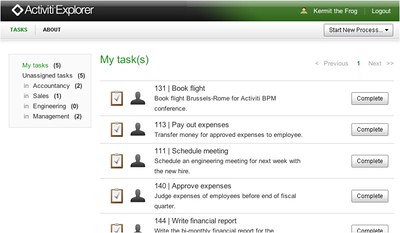
  • RUNA WFE 1.0.1, an open-source workflow based on JBOSS-JBPM was released. More details here, including a link to an online demo. Open source BPM is going to be a market force in some sectors, so best to be aware of what’s happening there.
  • Greg Wdowiak published an interesting post on the role of integration brokers within an integration stack. In particular, he discusses what you should expect to get from the integration broker portion of the stack, and where some of the vendors are lacking. If you’re new to EAI, you can read his excellent background post on bus versus broker models. In particular, he talks about how organizations move from a broker to a bus model as their integration needs become larger and more complex.
  • BEA buying Plumtree has been all over the tech news, with lots of interesting analysis. MWD blog thinks that the purchase may not be about what BEA says that it’s about, but more about moving away from complete Java-centricity and into a more neutral technology territory by supporting .Net. The Butler Group sees this as a better fit than some of the previous portal buy-outs, although an earlier post ponders the fate of the Plumtree-Fuego OEM agreement in light of BEA’s existing BPM strategy.
  • On the enterprise architecture front, The first issue of the Journal of Enterprise Architecture was published. Via Nick Mudge’s blog.

Lastly, if you’re free today at noon Eastern, there’s a webinar roundtable on Winning at BPM discussing IBM’s WebSphere process integration products.

Enjoy.

More open source BPM

An infrequently-updated but informative blog on open source BPM:

We share our discoveries in our search for open source workflow management tools. For tools that we find interesting, we download the code, try to execute the engine, or even get our reference process model working.

Also includes a list of open source BPM tools, including their evaluation notes where applicable.

Note that these are the only two sections of the site in English; for the rest, you’d better brush up on your Dutch (or use AltaVista’s Babel Fish translation utility, since Google’s translation doesn’t support Dutch).